
Mid-Winter in the Pacific Northwest
Is this really winter?

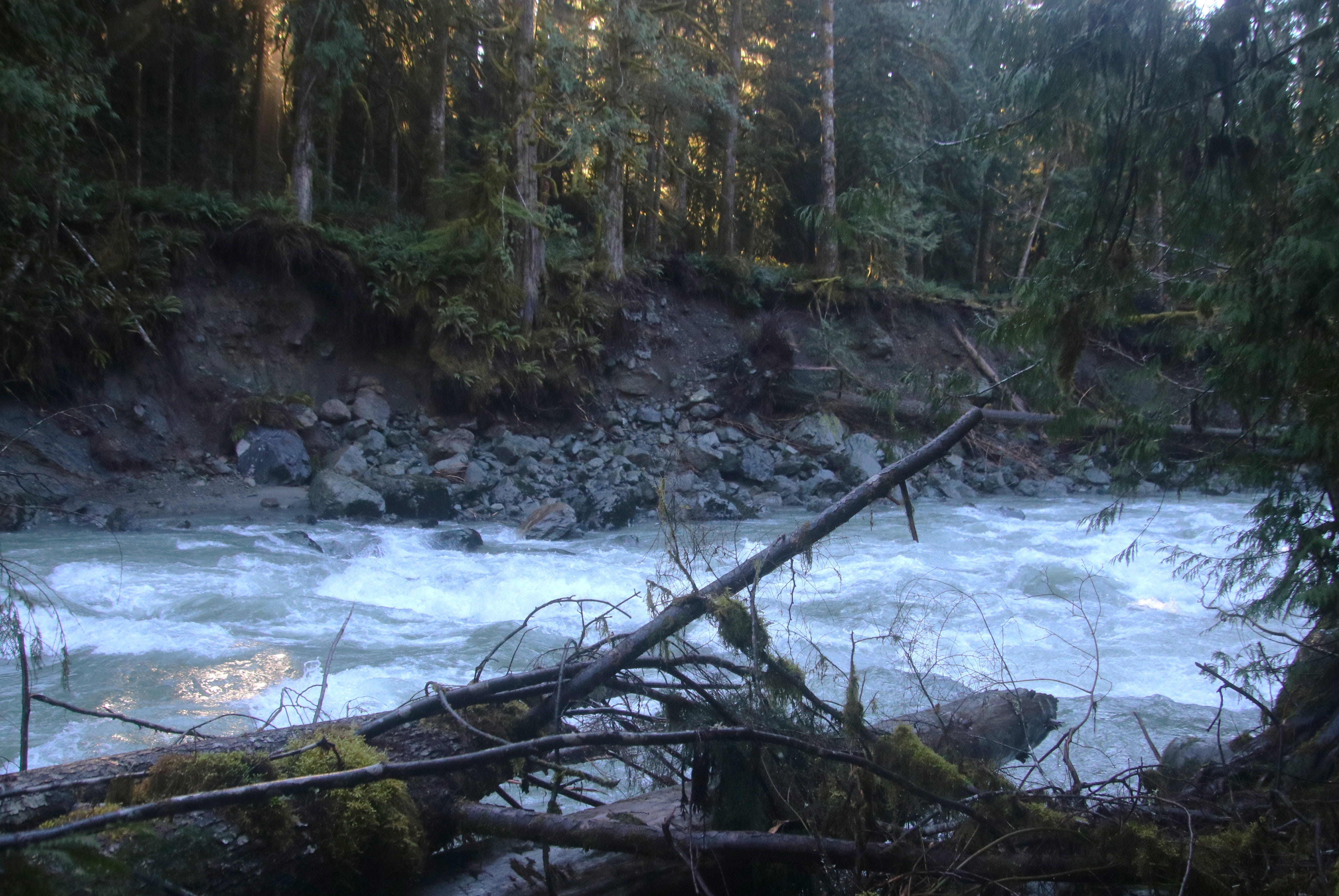
North Fork of the Nooksack River in Janurary shortly after a major flood that eroded and undercut the river bank, bringing down boulders and trees. The flood was a combinations of heavy rain and warm temps that melted snow on Mts. Baker and Shucksan.
Although it is mid-winter in the Pacific Northwest according to the calendar, the weather service might disagree. So far we have had only a few days where the thermometer hovered just above and just below freezing. It is early February as I write this and we are expecting temps tomorrow to be in the upper 50s F. In the mornings, it has been in the high 30s to mid 40s F. This is just right for hiking in the woods but not for showing frigid scenes of snow banks, iced power lines, and frozen duck ponds.
Floods:
But we do have precipitation - lots of it. January rain more than doubled our monthly average. Because of these clement temps and rain, we are short on snow pack in the mountsains and long on rivers flooding cities and farm land alike. A sad result was a house near the Nooksack River that was undercut like the photo above by the roiling waters and was shown floating down the river as if it were a house boat.
As a similar indication of the oddness of our winter here is the photo below illustrating the power of the flood and how fickle the temperatures were. In more typical years, this area would be covered in snow.
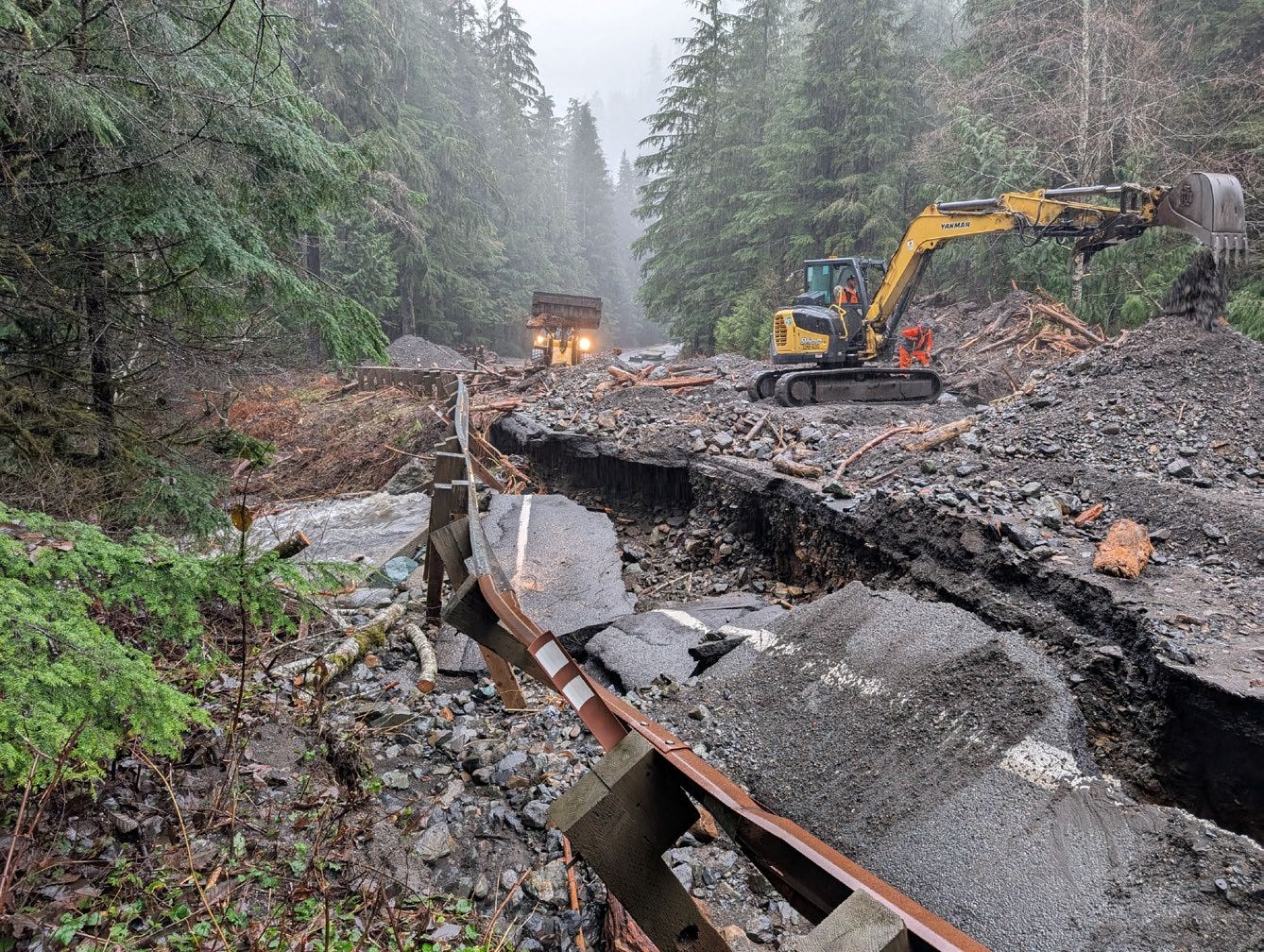
This is Highwy 542, at one of the many bridges that cross the Nooksack river. It is heavily trafficed as it is the only road access to the Mt. Baker Ski Area and the Mt. Baker Wilderness Area. And it is one of two highways to the Mt. North Cascades National Park. The reason for this bridge and road getting washed away this winter is that while the typical precipitation here is snow, this year it came as rain - all at once.
Eagle Watch:
Readers might recall my post a year ago showing eagles sharing a feast of spawned salmon carcuses on the Nooksack River. As I usually do, I went upriver again this year but not expecting much because of the recent floods. And indeed my low expections were met. There were no eagles because there were no shores or sand bars loaded with salmon for the eagles to eat. The floods had swept the dissicating salmon downstream and the sandbars were under water.
With nothing to see at our usual eagling spot, we went up river to the state salmon hatchery where there are usually some eagles hanging out. We saw just two there whereas typically many would be hanging out in the trees.


The two eagles observed at the salmon hatchery.
Wind on the Bay:
We have wind too but not typically of hurricane or tornado force, although it is often strong enough to topple trees in the forest. But wind on the bay is rather cool here. In December, we had a good blow when a southwest gale force wind kicked up some lively activity.
I could see from the house that the wind was stirring and tossing the bay around so I grabbed my camera and headed for a beach. By the time I got there, I could barely stand against the wind and it was too strong for the tripod and for me to steady my camera. I found a nearby tree sturdy enough to sustain me but small enough that I could get my arm around it. So, camera in one hand, tree in the other, I shot the following photos.
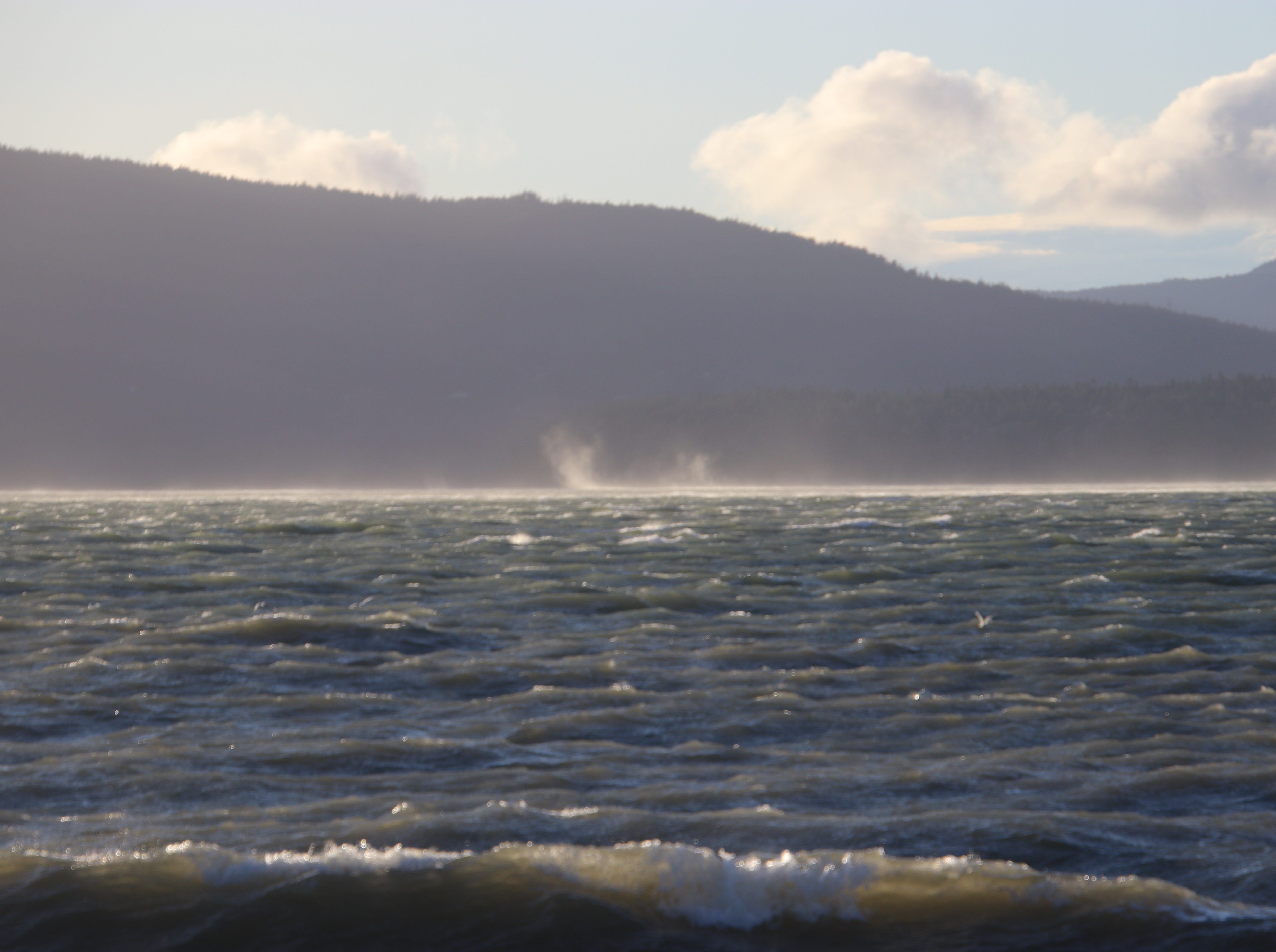
Fair weather water spouts whirling about across the bay with Lummi Island loomed in the background about seven miles away.
From this perspective you can see the wind swirling the water across the bay. The wind is blowing from the southeast which is left to right in the photo. What we see swirling are like dust devils on land. On the water these are sometimes called a “Fair Weather Water Spouts” although it is not a real water spout that climbs to the clouds like a tornado. My estimate is that the activity is about four miles out from where I was at Marine Park.
You can see the white streak of spindrift, blowing water across mid ground where the wind is at its strongest as that is the main path of a southeast wind blowing up Bellingham Channel. This is a stretch of open water that runs about 15 miles and it can really pick up speed through there.
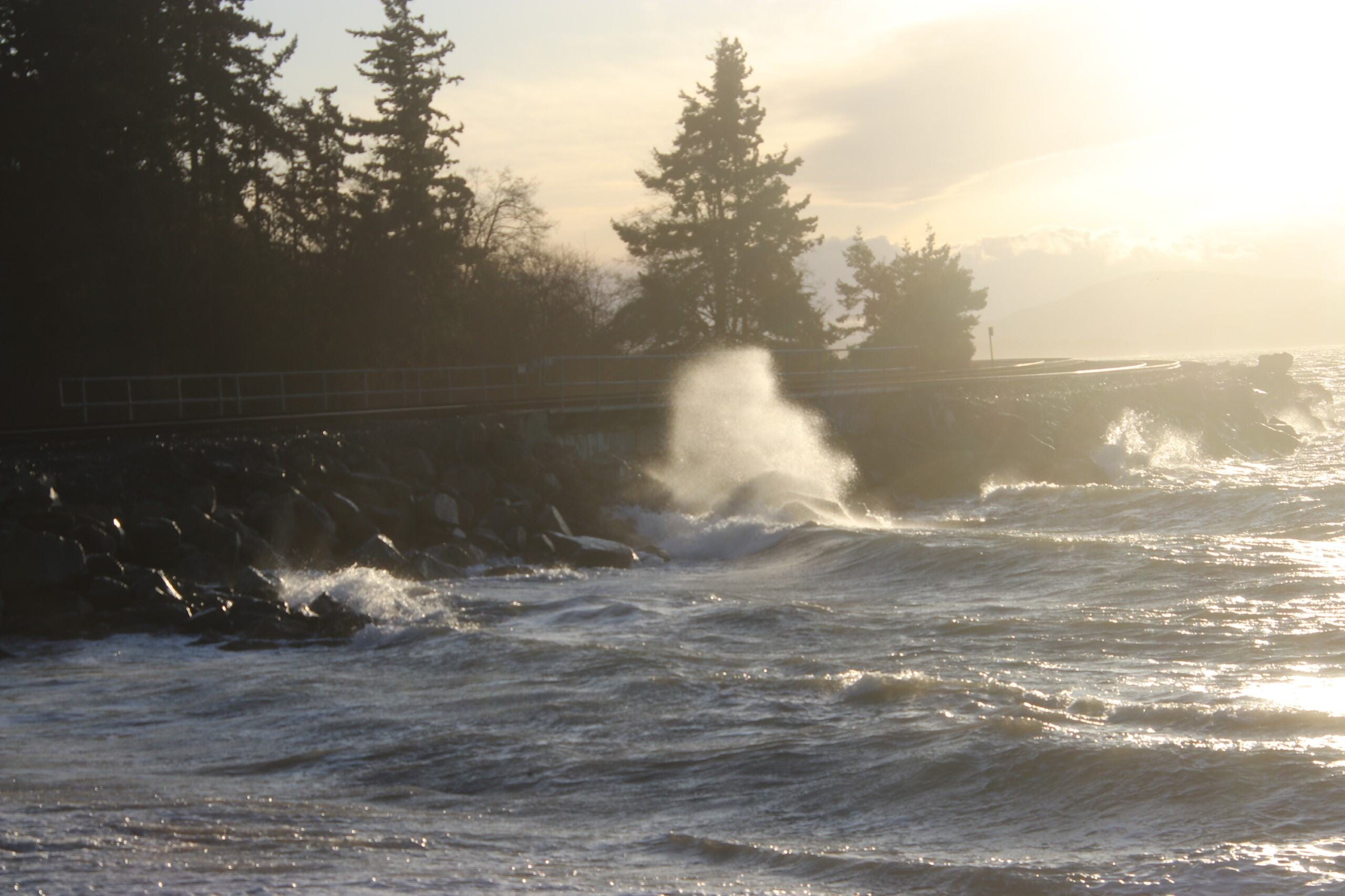
Here the waves are pounding the beach and the railroad ballast and berm that runs along the southeast side of the bay. The spray there is about 10 to 12 feet high.
Winter Fungi in the woods:
Winter is not typically a good mushroom foraging sesason but there are some interesting fungi about.
Late Oyster (Sarcomyxa serotina). This mushroom grows through the winter here and is considered edible by some while others get GI upset. In my opinion, it is more work than is justified by its taste or lack thereof. The later oyster is not a true Oyster mushroom (Pleurotus pulmonaria) which is considered choise by most mushroomers. The late oyster’s cap is covered with a slimey membrane that we are told should be pealed off before cooking and eating. Although it is not for me, I read that it is a favorite in Japan where it is called “Mukitake.”
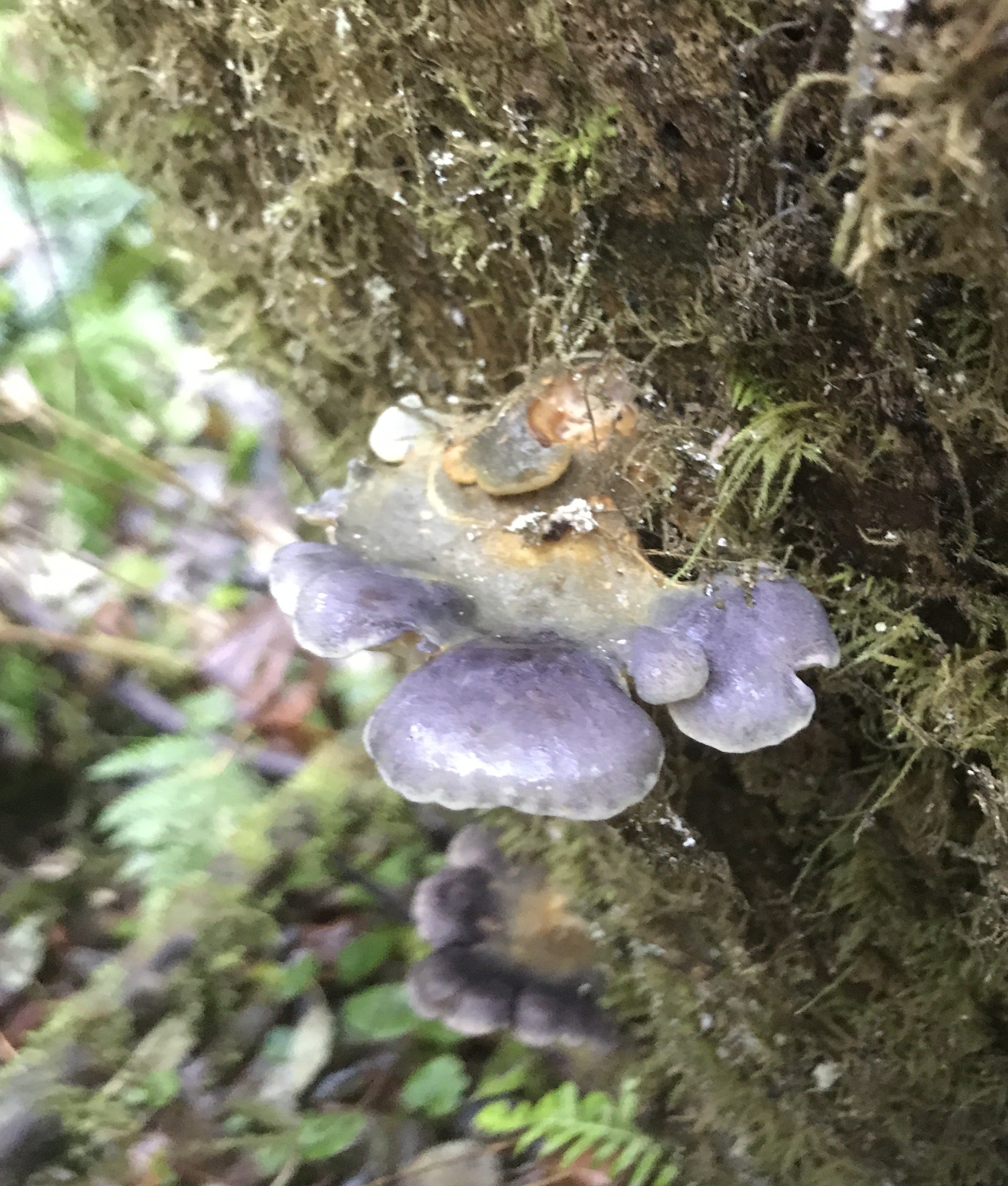
The purple color on this late oyster is a bit unusual. More typcially the color is the greenish-gray seen at its top here.
Coral Mushrooms: There are a couple of genera of mushrooms whose appearance is like that of salt water corals and that come out in the fall and winter. Corals are quite attractive and some are prized edibles while others are toxic. Sadly it is often difficult to differentiate among the various species as some change color as they age, so color is not a fool proof guide to edibility. Whether edible or not, they provide some nice color contrast against the abundant and verdant mosses.


On the left are some Red Coral (Ramaria araiospora) fungi that are highly desirable edibles, if that is what they are. On the right is a white or yellow coral that neither I nor iNaturalist were very sure as to its species.
Wax Caps: Another group of winter fungi are the cute wax caps of the Hygrocybe genus. Below are two of these small but colorful cuties.


On the left is the scarlet waxcap, sometimes “waxycap” (hygrocybe coccinea) and on the right is the butter waxcap (Hygrocybe ceracea). These pop up in my front yard every winter and I love their bright colors against the grass and moss.
Better yet many of these cuties are edible. Although mild in taste and small in size, they provide some great color in stir fries, stews, or any mushroom dish. However, some of them can cause GI upset, so one needs to be sure to identify properly. However none are poisoneous.
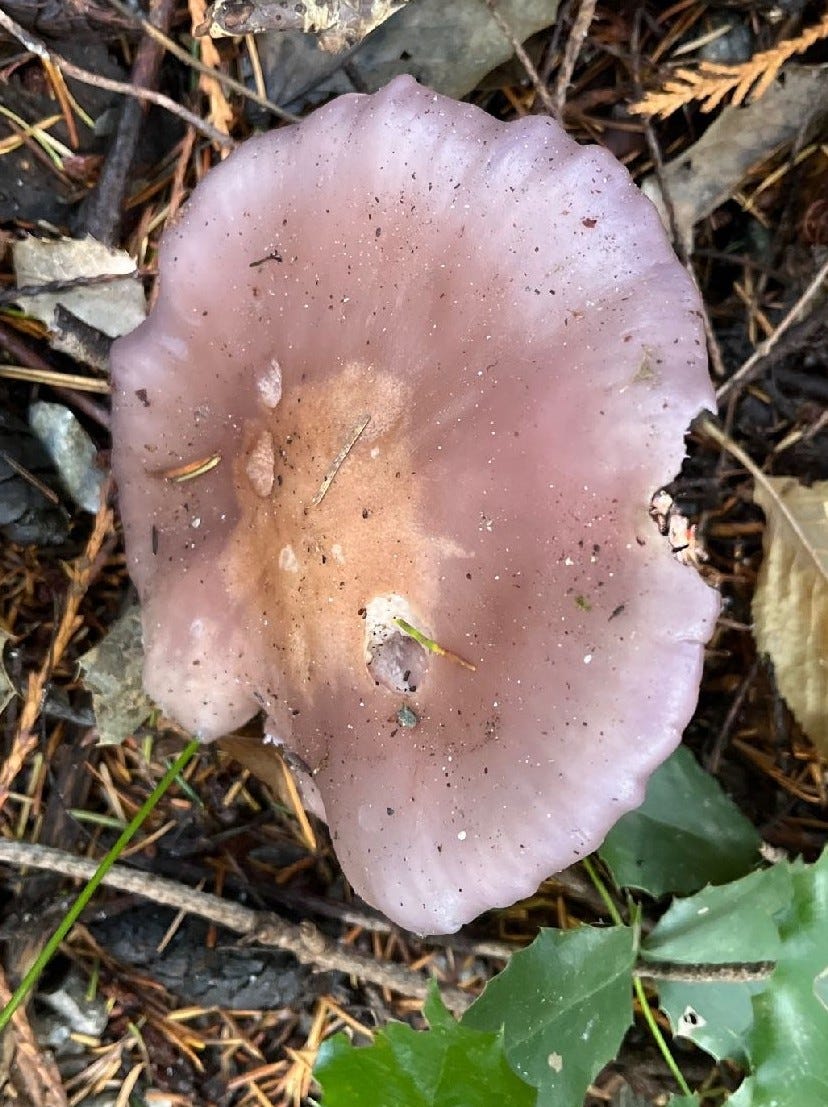
Blewit (Collybia nuda). This mushroom was a bit of an outlier. I showed this one in my late fall post but they were suppposed to be over by now as it typically fruits in late fall and into the early winter. Well this one did not get the message as I found it yesterday (Feb 20). As it was about 28 F. with a stiff north wind it was frozen solid. I took it home directly and put it into my freezer from where I will add it to my next batch of wild rice, chicken and mushroom soup. A wonderful lunch on a chilly winter’s day.
So, there is some of what has occupied me through the first part of the winter. Stay tuned for my early spring post. All sorts of plants green up and pop up for a new round of showing off their finery. The spring part can’t come soon enough.
This has been such an odd weather year in Oregon as well--60 degrees in January and ski resorts without enough snow to open. You have fantastic photographs (as always), but also really enjoying your observations & explanations that go along with the photos. Those coral mushrooms --wow!